Unbuffered: AI Safety, Automating Proof, and Seattle Traffic
AI safety and regulation
Few technologies have extinction-level potential: nuclear and biological weapons come to mind. We don’t allow private ownership of these – and in the US, even possession of fissile material or biological agents without proper authorization is a crime.
But we have essentially no limits when it comes to AI, even though all of the major players agree that it’s an existential risk to humanity.
We can’t put the genie back in the bottle, and I don’t think we’d want to, but we need to get serious about making sure that AI is developed in a way that’s beneficial. And the problem isn’t completely novel: we have precedent to consult.
Automating proof
The dream of automating proof ran from Leibniz’s idea of a formal language for mathematics through Frege and Russell to Hilbert’s Entscheidungsproblem (“decision problem”) in 1928:
The Entscheidungsproblem is solved once we know a procedure that allows us to decide, by means of finitely many operations, whether a given logical expression is universally valid or, alternatively, satisfiable. [Hilbert & Ackermann, 1928]
That is: find a theorem-proving algorithm.
And then, in 1936, Church and Turing put this dream to bed:
The general case of the Entscheidungsproblem … is unsolvable. [Church, 1936]
But as we’ve seen with the crush of recent results – including the resolution of some biggies like the Riemann hypothesis, the Navier-Stokes problem, and the exponential time hypothesis – the lack of a general decision procedure doesn’t mean that an algorithm (an AI) can’t prove theorems that have stumped humans for decades.
So although Hilbert’s dream won’t come to pass, a limited version is clearly possible, and for some worried about the role of mathematicians, it’s a nightmare. Terence Tao’s blog is a good place to watch this discussion unfold.
The Seattle traffic experiment
Vision Zero is Seattle’s mission to drive traffic fatalities to zero by 2030. Leaving aside the achievability of zero, reducing fatalities is clearly a laudable goal.
But with a chronically understaffed police force, there’s been no enforcement component to this effort. As a result, Seattle has effectively been running an experiment to see whether safety can be improved by structural means alone: reducing speeds and installing speed humps, banning right turns on red, delaying green lights, removing traffic lanes, etc.
Anecdotally, instead of getting safer streets, we seem to have bred more erratic, angrier drivers. Put up enough no-turn-on-red signs and people learn to ignore signs altogether. Delay green lights and people learn that they can safely run the reds.
And the data shows this failure to improve safety: Seattle’s 2025 Traffic Report compiles plenty of trends, mostly in the wrong direction.
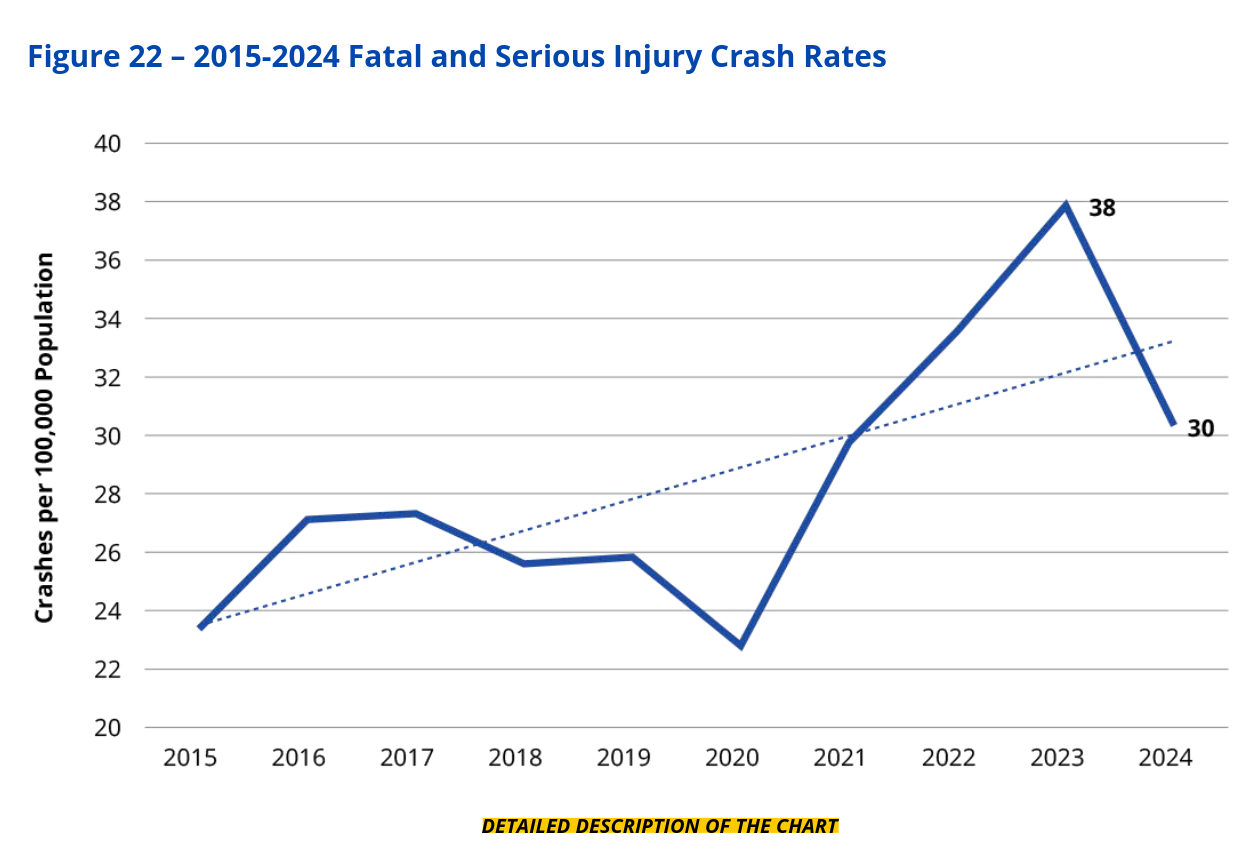
This seems like a failed experiment – will that matter?